


Medical coding is the basis for accurate reimbursement, compliance and documentation within healthcare facilities. All diagnoses, procedures and services offered by a physician have to be documented through proper coding. Though most physicians endeavor to achieve accurate coding, there are some specific coding practices that are bound to attract unnecessary attention from insurance payers.
Insurance payers are constantly analyzing claims information using sophisticated analytical programs and computerized auditing tools in an attempt to uncover billing irregularities and potential compliance issues. When such coding patterns deviate from what is considered normal, physicians are likely to end up on a payer’s watch list with all the accompanying adverse consequences.
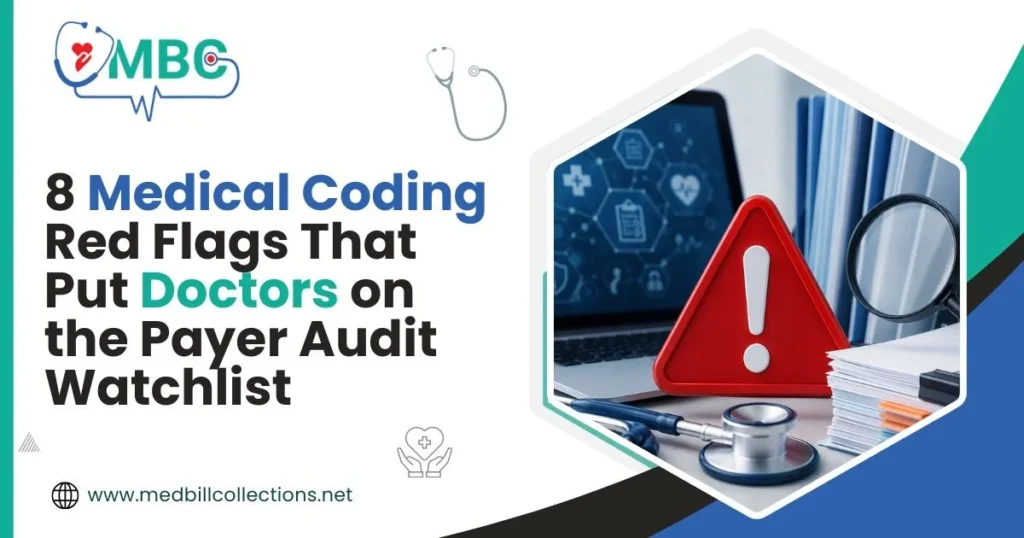
By being aware of those coding practices that may become triggers for the payers to take action, physicians will be able to improve their compliance record and minimize audit risk. Below are listed eight medical coding red flags that doctors should know about.
Excessive Use of High-Level Evaluation and Management Codes
The most frequently observed audit trigger in this context is the regular use of high-level E/M codes. E/M codes imply complex patient encounters which require complex medical decision making, documentation, and also substantial amount of physician’s time.
Although some specialties naturally tend to encounter complex patients, the payers compare the billing pattern of the physicians within the same specialty and same geographical location. If a physician regularly uses high-level E/M codes at an increased rate compared to other physicians within his/her specialty, then the payer might wonder if the documentation backs up the level of E/M code used.
The problem with upcoding occurs when the medical documentation does not support the complexity of the encounter. Even though patient care was provided correctly, lack of documentation makes it seem like upcoding. It is important for the physician to document accurately.
Unusual Billing Patterns Compared to Specialty Peers
Payers employ advanced benchmarking systems to examine whether billing practices differ significantly from those of similar practitioners. In cases where physicians have abnormal billing practices compared to other physicians within the same specialty, this can draw suspicion.
If an orthopedic specialist has billing practices that are far more frequent than his/her peers or a family practitioner has a higher amount of prolonged service codes compared to other similar practices, this could lead to a closer examination by payers.
However, being an outlier does not necessarily mean that something is suspicious. In many instances, some physicians simply have more complicated cases or provide unique treatments and services to their patients. Nevertheless, physicians should be aware of how their coding patterns differ from industry benchmarks.
It is highly advisable for physicians to regularly conduct internal audits on themselves.
Frequent Use of Modifier 25
Modifier 25 means that the physician conducted a separately identifiable evaluation and management (E/M) service on the same day as another procedure or service. Although this modifier performs the vital function of coding in medical claims, it remains one of the most closely examined coding aspects by insurers.
Some practitioners tend to abuse Modifier 25 when conducting an E/M service that is included in the procedural reimbursement. The frequent use of this modifier could imply that the practitioner tries to get paid for unnecessary services.
Payers conduct audits of those practitioners who have too much use of Modifier 25. It is important for doctors to prove that the E/M service provided on the same day as the procedure is distinct from the pre-procedure evaluation.
The physician’s record must show both a procedure and a separately identified E/M service.
Repeated Reporting of Medical Necessity Exceptions
The concept of medical necessity still ranks among the most significant ones in healthcare billing. Even if a procedure has been billed according to coding rules, the claim may be rejected if the payer feels that it has not been medically necessary.
Regular submission of claims that go beyond the payer’s guidelines, utilization limits, or even thresholds may become the object of payer’s audit. It concerns diagnostic tests, imaging studies, injections, therapy services, and some preventive procedures in particular.
In case of excessive utilization, doctors need to explain why it has happened in their notes. Thorough documentation of patient’s complaints, unsuccessful attempts to treat his/her condition, risks, and clinical picture can be considered as evidence of medical necessity.
The lack of the justification of medical necessity results in denial of claims and further audits.
High Volume of Unlisted Procedure Codes
The unlisted procedure codes apply to services without a designated CPT code. Although such codes may be occasionally required, their frequent use poses risks to payers.
Being manually reviewed codes, unlisted codes preclude automated claims processing and frequently pose questions about the accuracy of the reimbursement. Frequent use of these codes may indicate an attempt by the physician to increase reimbursement or violate the coding rules.
In any case, whenever it is possible, physicians need to use the most appropriate procedure code available. In case if the use of the unlisted code is required, proper supporting documentation needs to be provided.
Such communication will help avoid unnecessary audits.
Billing Services That Do Not Match Documentation
One of the worst possible audit red flags is when the billed services do not match the medical record. The payers perform audits on every bill sent to them and compare the claim against the documentation.
Some examples of such audit red flags are listing of a procedure which does not appear in the medical record, diagnosing something which is not supported in the medical record, or billing for a more complex service than actually performed.
The documentation should always cover everything that happened to a patient in one visit. All diagnoses, procedures, and services should be adequately supported in the medical record by the time the claim is filed.
Documentation training and coding classes for the doctors and other staff members will prevent audit red flags in the future.
Excessive Use of Time-Based Billing
Coding updates have created increased chances for time-based billing, especially for office visits and care management services. Although this offers much flexibility, compliance challenges emerge as well.Insurers pay close attention to providers who bill for extended office visit time, long service times, or any other codes related to time that appear in large amounts. In case of time-based billing, the documentation should be clear about total time spent and activities conducted.
If documentation is not detailed enough or not clear, it raises questions about the appropriateness of code use. The phrase “spent significant time with the patient” is usually not sufficient.
Providers need to document total time, counseling, care coordination, record review, and other services used to justify codes used.
Conclusion
Payers have been making use of the latest technologies to perform audits since they need to analyze coding practices through advanced data analytics and ensure the absence of any compliance issues. Doctors that know what signs may alert payers to investigate further will be able to prevent any problems related to coding practices in advance.
Overcoding for high level E/M, unusual peer comparison results, frequent use of Modifier 25, medical necessity issues, heavy use of unlisted procedures, documentation issues, frequent time-based billing, and high rate of corrected claims are among the most common coding practices that make payers conduct an audit.
The key way to avoid auditing is creating a compliance environment based on proper documentation and regular coding training, internal audits, and performance monitoring. The earlier a doctor will be aware of any coding weaknesses, the sooner he will be able to eliminate them and save his money from any losses.
In general, coding compliance is much more than just avoiding audits. It is Affordable medical coding services that can be of great help.