


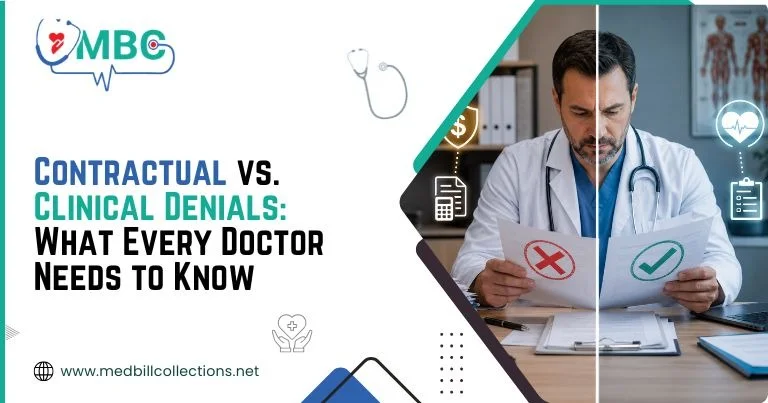
Denials of medical claims continue to be among the greatest problems facing doctors when it comes to their financial gains and business practices. Each and every claim denial means lost money and time for processing. Though a lot of physicians know that there is such a problem, fewer understand the fact that all claims are divided into two main groups – contractual and clinical. It is very important to distinguish between these types of denials, as each of them requires its own approach to prevention, to appeals and even to operations.
If a doctor is able to determine the real reasons behind the denial of a claim, he will have more chances of increasing his reimbursements and strengthening his relations with the payer.
Understanding Medical Claim Denials
The term medical claim denial refers to the insurer’s refusal to pay out a certain part of a claim for healthcare services. There are many possible reasons behind claims denials, including errors in documentation, coding, authorization, eligibility, or disagreement on medical necessity.
Denials differ in terms of their source. Some of them have to do with administrative issues or the contractual relationship between the payer and the provider, whereas some have to do with the clinical aspect of treatment. Knowing what kind of denial you are dealing with is important to take the right steps.
The inability to differentiate between denial types results in inefficiency of the appeals process, time waste, and fewer payments collected.
What Are Contractual Denials?
Contractual denials take place where the claim does not comply with the terms and conditions that have been defined in the provider’s agreement with the insurer. Contractual denials do not consider medical appropriateness of care and are more about adherence to administrative criteria.
A number of contractual denials result from non-adherence to criteria defined by insurers in the contract. Such criteria include timeliness of claims filing, prior authorization, network participation, and coding.
In some cases, for instance, even if the physician provides medically appropriate treatment, the patient will not receive payment for this treatment due to filing past the insurer’s deadline for submission of the claim. Similarly, failure to get the prior authorization may also result in a denial irrespective of the appropriateness of treatment provided.
The nature of contractual denials makes them easy to prevent in most cases.
Common Causes of Contractual Denials
Contractual denials are caused by a number of reasons in different healthcare institutions.
The first reason of such denials is late filing of claims by patients. Payers have certain time limits when it comes to claims filing and missing those leads to an automatic denial of the claim.
Authorization related issues also account for a considerable number of denials. When no referral or prior authorization is made before performing a service, claims are denied.
Eligibility errors also lead to a considerable number of denials. The absence of coverage, inactivity of the insurance policy, and incorrect patient demographics make up one more cause of contract denials.
Claim coding errors are also responsible for denials. Inaccurate modifiers, incorrect code of procedure, and incomplete information on claims are not accepted by the payer and rejected.
Other causes of denials include duplicate claims, incorrect coordination of benefits, and out-of-network services.
What Are Clinical Denials?
Clinical denials arise when the payer challenges the medical necessity, appropriateness, or clinical indication for the service rendered to the patient. This type of denial is contrary to the contractual denials, which rely on the administrative compliance process.
The insurance carrier will determine whether the treatment adheres to the established medical guidelines. In case the payer decides that there is a lack of sufficient clinical evidence, the claim may be denied.
Clinical denials are usually conducted through the assessment of medical directors, nurses, or utilization management staff. These individuals examine the documentation, rationale for the treatment, diagnostic codes, and patient data to determine whether the criteria for the reimbursement have been met.
Since clinical denials depend on the medical decision-making process, physicians will be required during the appeal process.
Common Causes of Clinical Denials
The most frequent type of denials among all types of clinical denials is medical necessity denials. In this case, the payer does not find that treatment was medically necessary for that particular patient’s condition or that other more cost-effective treatments should have been tried initially.
Lack of proper documentation is also one of the major reasons of denials. In such a case, even though the care might be necessary, lack of documentation does not prove the necessity of the care.
When a payer finds that the procedure, treatment, or drug being used on the patient is experimental or investigational and there is no sufficient evidence supporting the use of this particular service in that particular plan, it is considered as clinical denial.
Length of stay issues also arise commonly among hospital-based practitioners because payers find that an inpatient stay could have been handled as observation or that the length of stay was unnecessarily long.
Key Differences Between Contractual and Clinical Denials
The fundamental difference between contractual and clinical denials is in the reason behind the denials.
While contractual denials look at administrative issues, they assess whether the provider has been compliant with their contracts with regard to receiving authorizations, filing claims in time and other similar aspects.
Clinical denials look at the medical care itself and assess whether the medical care rendered has been medically necessary and properly documented according to payer guidelines.
The parties responsible for dealing with the two types of denials are different too. While contracting denials are handled by billing, coding and revenue cycle staff, clinical denials will also need physician involvement.
Methods of appealing these denials are different too. While in appeal of contractual denials will be based on addressing administrative mistakes or proving the compliance with the contract, clinical denial appeals will have to prove the necessity and adequacy of medical care provided.
Financial Impact on Medical Practices
Both forms of denial have the potential to heavily impact physician revenues; however, the financial implications of each type could be different.
Contractual denials tend to be quite common due to operational and workflow problems. Sometimes a minor administrative error could result in consistent payment issues with hundreds of claims.
Clinical denials are less common but generally deal with larger claims, especially when it comes to complex procedures, sophisticated diagnostic tests, specialized treatment methods, and hospital-related services.
It could be rather expensive to process denied claims, which require much effort from employees who investigate the denials, provide the necessary documents, appeal and negotiate with the payer.
Continuous denials could also influence physician productivity by shifting the focus from patient-oriented services to revenue recovery operations.
Strategies to Prevent Contractual Denials
Contractual denials can only be prevented by effective revenue cycle management.
Practices should check the eligibility of patients at every visit to know the problems in advance. Insurance details need to be updated periodically to submit accurate claims.
Authorization procedures should be standardized, and their implementation needs to be closely monitored. The staff should be knowledgeable about the payer policies and get approvals for services being provided.
Claim scrubbing software can detect coding mistakes, missing details, and violation of payer policies even before the claim is sent out.
Contract reviews on a regular basis are also critical for minimizing contractual denials. Understanding the changing rules and requirements of payers would help in denial management for doctors
Conclusion
Denials related to contracts and clinical aspects present two different types of issues in the revenue cycle process of the healthcare system. Denials of contractual type occur due to failure to comply with the payer policies, whereas clinical denials relate to medical necessity and appropriateness of treatment. Distinguishing these types of denial is vital for physicians in order to use preventive measures and to increase their chances of appealing successfully.
Using effective administrative controls together with thorough documentation is the key to decreasing the number of denials and preserving the income for healthcare organizations. In the modern reimbursement environment, being aware of the difference between contractual and clinical denials is crucial.