
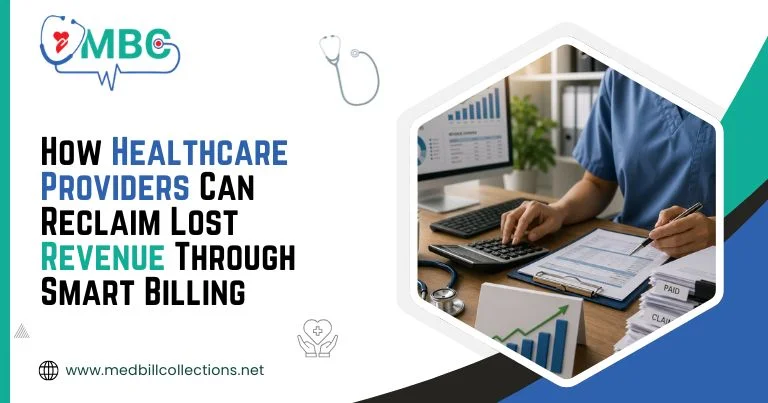
How Healthcare Providers Can Reclaim Lost Revenue Through Smart Billing

How Healthcare Providers Can Reclaim Lost Revenue Through Smart Billing

There is no doubt that health care organizations go out of their way to ensure quality treatment to patients; however, most of them fail to get the revenues that are due to them. Revenues are lost due to various reasons, including billing errors, late claim processing, coding issues, insurance denials, and other inefficiencies in the administration process. Minor billing errors can lead to losses running into thousands of dollars. Effective billing techniques allow health care organizations to pinpoint sources of revenue leakages and optimize reimbursement ratios.
Understanding Revenue Leakage in Healthcare

Revenue leakage takes place when healthcare organizations miss out on collecting the entire money that should be collected for the services provided by them. This happens at any phase in the process of revenue cycle, starting from registration up until payments are collected. There may be several reasons, such as missing insurance information, improper coding, duplicates in claims, underpayments, and improper follow up of denied claims.

Most of the organizations wrongly believe that there is no way one could recover this money. Actually, most of the lost revenues are recoverable by improving the process of billing and auditing. The very first step in recovering money is knowing the source of the leakage.

Improving Patient Registration Accuracy

Proper patient registration sets up the stage for efficient medical billing. Errors that are made in the patient’s demographics, the insurance information of the patient, or in their records generally cause rejection of the claim before the payer reviews the services delivered by the medical institution.

The front desk needs to check whether the patient’s insurance is eligible at all, verify patient’s contact information, and obtain referral/authorization if necessary. Electronic verifications can help automate most of this process.

In case registration is done correctly right away, the claims processing goes much smoother.

Using Accurate Medical Coding

Medical coding has a direct impact on reimbursement. It is essential that all diagnoses, procedures, and services be properly coded according to current guidelines. Improper coding can lead to underpayment, denial, compliance issues, or audits. Certified medical coders will know about changes in coding each year, and will be familiar with payer specific coding rules. Coding education will ensure providers document services sufficiently for proper coding.

Coding audits will help detect any trends in improper coding that might cost you money. Proper coding will maximize your reimbursement while protecting you from any compliance problems.

Reducing Claim Submission Errors

The reason for denial of many claims is due to avoidable administrative errors rather than any medical necessity. Errors like the absence of modifiers, provider ID errors, incorrect diagnosis codes, or lack of documentation lead to denials of claims.

Today’s advanced billing systems carry out the process of claim scrubbing before sending the claim to ensure errors are spotted and corrected.

By ensuring that only clean claims are sent, one can increase the chances of acceptance at the first attempt.

Monitoring Insurance Denials Closely

Unpaid claims form one of the biggest causes of lost revenue in the health care sector. Regrettably, most providers are unable to submit appeals for denied claims either late or not at all.

Each claim denial needs to be classified by what causes it. Some of the categories under which denials may be classified include eligibility denials, authorization denials, coding denials, denials of medical necessity, duplicates, and documentation denials.

Identifying and tracking patterns of denials makes it possible to correct the identified problem and prevent similar ones from happening again in the future.

Strengthening Clinical Documentation

Proper documentation helps in proper coding and proving medical necessity for all services rendered. Inadequate and vague clinical documentation can lead to denied claims and claims being coded at a lower level than appropriate.

Documentation in terms of patient history, physical examination results, diagnosis, plans of treatment, procedures carried out, and medical decision-making should be done by the providers.

Good documentation helps the provider in case of any audit, as well as reimbursement for the best possible level of service rendered.

Automating Revenue Cycle Processes

Automation saves time and effort, ensures consistency, and expedites the reimbursement process. Current revenue cycle management systems automate numerous processes related to billing, such as verifying eligibility, capturing charges, submitting claims, posting payments, monitoring denials, and billing patients.

Automation prevents errors and allows the billing staff to concentrate on more important functions, like managing denials and communicating with patients.

By implementing automation, healthcare institutions are likely to see a shorter payment process, reduced expenses, and enhanced financial efficiency.

Conducting Regular Billing Audits

Routine billing audits help uncover hidden revenue opportunities that might otherwise remain unnoticed. Internal audits evaluate coding accuracy, documentation quality, payment posting, payer compliance, and billing workflow efficiency.

External audits provide an independent assessment of billing performance and may reveal overlooked reimbursement opportunities or compliance concerns. Audits should not be viewed solely as compliance exercises. They also serve as valuable financial tools for identifying underpayments, billing inconsistencies, and operational improvements that increase revenue.

Following Up on Outstanding Claims

It is surprising to note that many healthcare professionals miss out on earning money due to uncollected claims. It sometimes happens that insurance firms delay their payments, ask for extra documentation, or handle claims improperly.

Healthcare organizations must have an aging report that helps identify claims which need to be followed up. Claims must be checked in line with the payer deadlines in order to lodge an appeal if needed.

The follow-ups will often lead to the recovery of money that would have been lost.

Verifying Contractual Payments

Getting paid does not always mean getting paid the right amount. At times, insurance companies make underpayments due to administrative problems, out-of-date fee schedules, and contractual problems.

Healthcare facilities need to check how much they have been paid relative to the contracted amount of payment. Through automated software of contract management, it is possible to detect underpayments.

Even modest underpayments can amount to a significant source of extra income if there are many of them.

Conclusion

The process of recovering any lost income goes beyond filing insurance claims. The process involves having an effective billing approach which focuses on accuracy, efficiency, technology, compliance and improvements. Through improved patient registrations, medical coding, claim accuracy, proactive denial management, automation of the billing process, financial auditing, verification of reimbursements and training of staff, the providers of healthcare services can ensure significant improvement of their revenue streams through increased efficiency.

Modern medical billing services turns the revenue cycle management process from being just an administrative task to an effective financial strategy. As the process of health care payments becomes more complicated, organizations which incorporate modern billing will be able to effectively improve their financial performance and sustainability.