


Lower back pain is one of the most common reasons people walk into a doctor’s office. It affects nearly 80% of adults at some point in their lives. For medical coders, this means back pain cases show up almost every single day. And one code keeps coming up more than almost any other — M54.50.
People look for it in various ways – ICD 10 M54.50, M54.50 diagnosis code, ICD 10 code M54.50 – but they are all looking for the same thing! If you have ever asked yourself when, or even how, it differs from other codes with similar names, or why it is a big deal, you are not alone. Let’s go through it step by step and simply.
What Exactly Is ICD-10 Code M54.50?
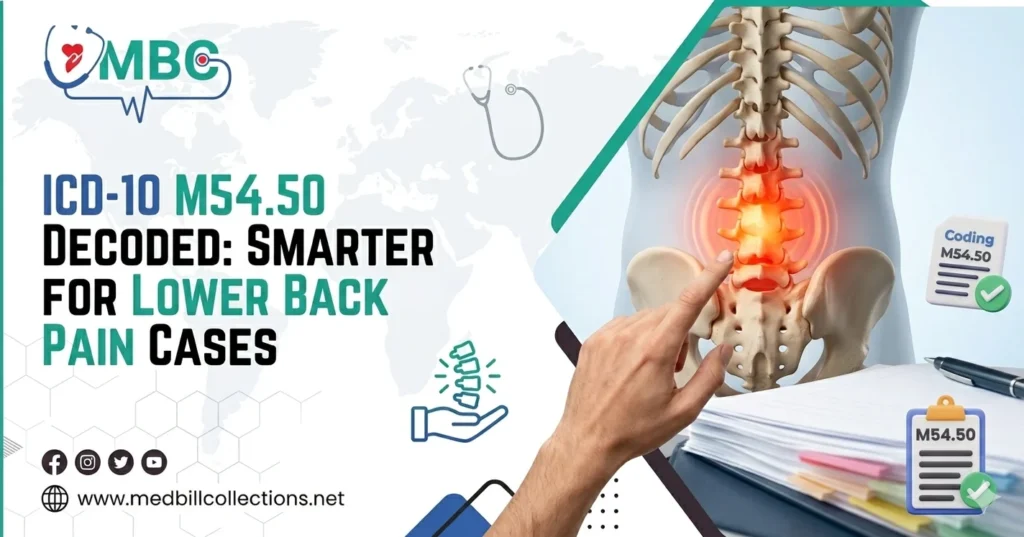
The M54.50 diagnosis code means “Low back pain, unspecified.” Simple as that.
Used when a patient presents with lower back pain but the doctor has not been able to identify a specific cause: no disc problem, no fracture, no nerve problem. Just a low back pain with no specific cause.
Let’s say a patient walks in and tells you that he’s had a problem in his lower back for the past 2 weeks, and after examining him, the doctor still can’t say exactly what is wrong with him. Well, that’s your ICD 10 M54.50 moment. This is where the word unspecified is important. It doesn’t mean the pain is not true. It simply means that the cause has not been confirmed at this time.
Why Do Coders Get This Wrong So Often?
Honestly? Habit. A lot of coders will go to ICD 10 code M54.50 without determining if there is a more specific code. That’s where the issue begins.
There are multiple ICD-10 codes for back pain, and selecting the incorrect code can impact your claim, your reimbursement, and your compliance. Some of the codes that can be confused with the M5450 DX code are:
|
Code |
What It Means |
| M54.51 |
Vertebrogenic low back pain |
|
M54.59 |
Other low back pain |
| M54.4x |
Lumbago with sciatica |
|
M54.3x |
Sciatica |
| M51.16 |
Lumbar disc degeneration |
If it says it’s coming from the vertebrae, then you should use the M54.51 ICD 10 code, rather than the M54.50 ICD 10 code. You’ll need an ICD-10 code if you have leg pain due to sciatica. For leg pain caused by sciatica, you should use M54.4x.
The basic principle is “be as specific as the documentation allows”.
When Is M54.50 Actually the Right Code to Use?
Use the M54.50 diagnosis code when:
- The notes say “low back pain” with no further details
- No specific cause has been confirmed
- It’s an early visit, and tests haven’t come back yet
- The provider uses general words like “lumbago” or “backache” without explaining why
Do not use ICD 10 M54.50 when the provider clearly names a specific cause. If the notes say “lumbar disc herniation causing back pain,” you code the disc condition — not the pain alone.
A Real Example to Make It Click
Let’s say a 48-year-old man arrives and reports that his lower back has been bothering him for 3 weeks. The doctor checks him out, finds tenderness in the lumbar area, and orders an X-ray. The visit notes read: “Patient has a complaint of lower back pain, cause under investigation.
Certainly, it is a case for the ICD-10 code, M54.50. No confirmed diagnosis. Pain is real. The cause is still unknown. Then, when the X-ray is returned and the post-examination, “lumbar spondylosis” is confirmed. Then would be the time to choose M47.816. The code changes due to a change in the clinical picture. No wonder that is the way it goes.
The Role of Medical Coding Services in Getting This Right
Back pain is a common complaint, but it’s not easy to code. An error here and there becomes a problem that quickly when you’re handling hundreds of claims a month, especially regarding denials, lost revenue, and audit risk.
That’s why a lot of providers across the country trust professional medical coding services USA teams to manage this. It’s a code that’s used every day by specialists, and they know exactly the situations where it’s appropriate to use M5450 dx code and when something more specific is appropriate. Fewer mistakes. Cleaner claims. Reduced transaction costs with payers. This is the reward of having a good team on your side.
Documentation Makes or Breaks the Code
Documentation is the Key to code, success, or Failure. One thing coders want to see more of is understanding: If it isn’t documented, it can’t be coded. If the notes are not clear, the code will not be clear. If the notes are clear and detailed, coders can select the appropriate code, which makes a huge difference to the claim.
Ask providers to document:
- Where the pain is (lumbar, sacral, etc.)
- Any other symptoms — does it shoot down the leg? Is there numbness?
- Known conditions that might be related
- What treatment has been tried, and how the patient responded
Better notes mean better code. It’s that simple.
Back Pain Doesn’t Always Come Alone
Here’s something coders run into all the time: back pain showing up alongside other conditions. Obesity, diabetes, and chronic fatigue these things often travel together.
When a patient is being treated for more than one thing in the same visit, each condition needs its own code. For example, if a provider is also handling an ICD-10 code for weight loss medication management in the same encounter, that needs to be coded separately and accurately alongside the back pain code.
Codes like E66.09 for morbid obesity might also be relevant depending on what’s documented. Missing these secondary codes means an incomplete record and often, money left behind.
This is exactly where a well-trained coding team earns its keep. They don’t just look at the chief complaint. They look at the whole visit.
Mistakes to Watch Out for with M54.50
Here are the most common slip-ups coders make with this code:
- Using M54.50 when a more specific code exists — always go as specific as you can
- Forgetting to update the code — if the diagnosis gets clearer at a later visit, the code should change too
- Missing sciatica laterality — M54.41 (right side) and M54.42 (left side) are not the same as M54.40
- Skipping secondary diagnoses — conditions that affect or complicate back pain should be coded too
Final Thoughts
Lower back pain is something almost every coder deals with daily. But “common” doesn’t mean “easy to code correctly.” The M54.50 ICD 10 code is the right choice for unspecified lower back pain, but it’s not something you should pick by default every time.
Read the documentation. Check if something more specific fits. Update the code when the diagnosis becomes clearer. And when the volume gets too high to manage cleanly in-house, lean on a team that does this every day.
Take a look at your back pain claims from the last 60 to 90 days. If M54.50 is showing up on almost everything, that’s worth a second look and possibly a conversation with a coding specialist.