


Like health, the financial well-being of a medical office is crucial. Despite this, billing and revenue continue to be a constant headache for many doctors in the United States, a place of lost income and compliance risk.
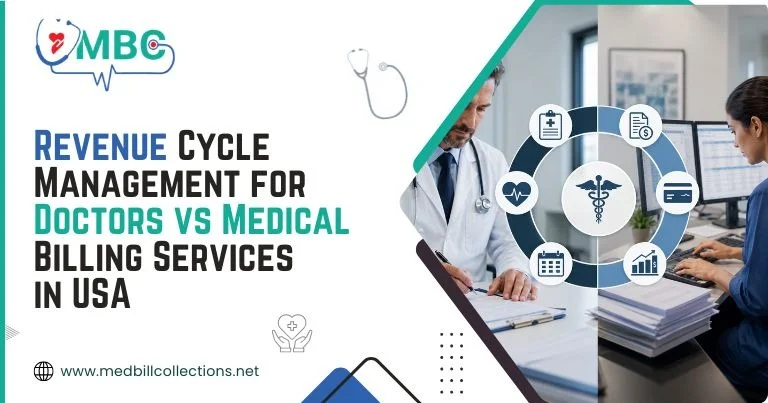
This blog examines two key ways of managing your practice’s finances: managing Revenue Cycle Management (RCM) yourself or outsourcing to a medical billing service, and which of those two is better for your practice.
What Is Revenue Cycle Management?
Revenue Cycle Management (RCM) refers to the complete financial process that healthcare providers use to track patient care from the initial appointment to the final payment. It covers:
- Patient registration and eligibility verification
- Charge capture and medical coding (ICD-10, CPT)
- Claims submission to payers
- Payment posting and reconciliation
- Denial management and appeals
- Patient billing and collections
According to the American Medical Association (AMA), physicians spend an estimated $99,000 per physician per year dealing with insurance-related administrative tasks. Getting RCM right isn’t just a back-office concern; it directly affects clinical sustainability.
Option 1: In-House RCM by Doctors and Their Staff
Many smaller and independent practices choose to handle billing internally. A doctor or office manager oversees the billing staff, monitors claims, and manages payer relationships directly.
Advantages of In-House RCM
Full control and visibility.
You have direct oversight of every claim, every denial, and every payment. Sensitive patient data stays within your four walls.
Immediate communication
Your billing team sits down the hall. When a coding question arises or a claim needs clinical context, the turnaround is faster.
Practice-specific expertise
Over time, an in-house team becomes deeply familiar with your specialty, your payers, and your patient population.
Challenges of In-House RCM
High overhead costs
Salaries, benefits, training, and billing software can cost a mid-sized practice anywhere from $50,000 to $150,000+ annually per billing staff member when full-cost accounting is applied.
Staff turnover risk
Losing a key biller mid-year can stall your cash flow for weeks.
Keeping up with compliance changes
Coding updates, payer policy shifts, and regulatory requirements, like HIPAA audits and CMS guidelines, demand constant staff education.
Scalability limitations
As your practice grows, your billing needs grow too. Scaling an in-house team is slow and expensive.
Option 2: Outsourcing to a Medical Billing Service
A professional medical billing company takes on your entire revenue cycle, or specific components of it, on your behalf. These companies employ certified coders, denial specialists, and AR analysts who work across multiple practices and specialties.
Advantages of Outsourcing
Lower cost structure
Most billing services charge between 4% and 9% of collections, meaning you only pay when you get paid, a performance-aligned model.
Access to specialized expertise
Billing companies employ AAPC-certified coders and denial management specialists who stay current on all payer rule changes.
Improved clean claim rates
Industry data from MGMA (Medical Group Management Association) shows that top-performing billing services achieve clean claim rates above 95%, compared to the national average of around 75–85% for in-house teams.
Scalability on demand
Adding a new provider or opening a second location doesn’t require hiring more billing staff.
Challenges of Outsourcing
Less direct control
You’re trusting a third party with your financial operations. Choosing a poor-fit vendor can create more problems than it solves.
Communication lag
Questions requiring clinical clarification may take longer to resolve if the billing team is off-site.
Contract dependencies
Switching billing companies mid-year can disrupt cash flow and require significant data migration.
The Hybrid Model: A Growing Trend
Many growing practices today adopt a hybrid approach, keeping front-end functions like patient scheduling and eligibility checks in-house while outsourcing complex coding, claims submission, and denial management to specialists.
This model captures the benefits of both worlds: physician oversight on patient-facing tasks and professional-grade expertise on the technical revenue side.
When Professional RCM Services Make the Most Sense
Once a practice reaches a certain scale or encounters persistent billing challenges, the value of dedicated RCM services becomes undeniable. Here’s when you should seriously consider making the switch:
- Your denial rate exceeds 10% (industry benchmark is under 5%)
- Your Days in Accounts Receivable (AR) are above 40 days
- You’re losing more than 3–5% of revenue to write-offs
- You’re planning to expand your practice, hire new providers, or add new service lines
- Your in-house team struggles to keep up with payer policy changes or coding updates
Professional RCM services don’t just process claims; they analyze trends, identify revenue leakage, and apply systematic improvements that compound over time. A well-implemented RCM strategy can improve net collections by 10–20% for practices that previously relied on under-resourced in-house teams.
Understanding Revenue Code Listing in Medical Billing
One area where professional billing expertise pays dividends is accurate revenue code listing. A revenue code listing is a standardized set of three- or four-digit codes used primarily on UB-04 claim forms (used by hospitals and facilities) to identify specific accommodation, ancillary services, and billing categories…
Common examples include:
|
Revenue Code |
Description |
|
0110 |
Room and Board – Private |
|
0250 |
Pharmacy |
|
0300 |
Laboratory |
|
0450 |
Emergency Room |
|
0636 |
Drugs requiring detailed coding |
Incorrect or incomplete revenue code listing is one of the top reasons facility claims are rejected or underpaid by Medicare and commercial payers. A billing service with facility billing expertise ensures every line item maps to the correct revenue code, protecting both compliance and reimbursement.
Key Questions to Ask Before Deciding
Whether you’re a solo practitioner or a multi-specialty group, use these questions to guide your decision:
- What is my current clean claim rate and denial rate?
- How much time does my staff spend on billing versus patient care support?
- Am I leaving money on the table due to coding errors or missed charges?
- Do I have the bandwidth to train and retain qualified billing staff?
- What’s my growth plan for the next 12–24 months?
Conclusion: Revenue Optimization Is a Strategic Priority
There’s no universal answer to the in-house vs. outsourced RCM debate. A solo family physician who has a low complexity patient panel can be successful with a smaller in-house team. If your orthopedic group is handling hundreds of claims a day from several payers, you are most likely getting the benefits of a dedicated professional RCM services provider.
The most important thing is to make a conscious and informed choice, rather than picking any system you inherited.
Looking for some advice on what you should do? First of all, review your bills. Check your AR aging report, determine your denial rate, and know your cost-to-collect. The numbers will provide you with a clear indication of your position and the changes that need to be implemented.