


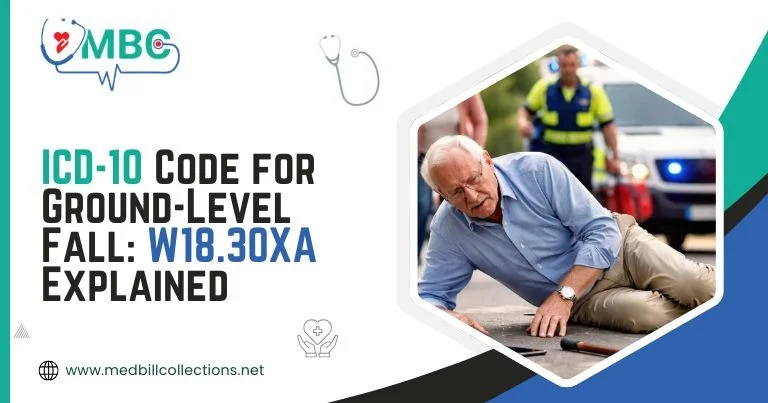
A patient walks into the clinic after slipping in the bathroom. No stairs, no height, no ladder, a mere fall, on the same level. This may seem small, but in coding and billing, the correct ICD-10 code is required in this case.
That’s where W18.30XA comes in. The ICD-10 code W18.30XA is defined as fall on same level, unspecified, initial encounter. It is a billable code that is applied in cases where a patient has experienced a fall on the ground, and it is the first time that he or she is under active treatment.
This code belongs to Chapter 20 of ICD-10 that deals with external causes of morbidity, i.e. it does not describe the injury but how it occurred.
What is a Ground-Level Fall in ICD-10?
A ground level fall ICD 10 situation refers to a fall where the patient does not fall from a height. It usually happens due to slipping, tripping, or losing balance on a flat surface.
Examples include:
- Slipping on a wet floor
- Tripping over an object
- Losing balance while walking
Although these falls occur on the same level, they may result in severe injuries such as fractures, head injuries, or soft tissue injuries. This is why documentation and coding are important.
Understanding W18.30XA in Simple Terms
The full breakdown of W18.30XA looks like this:
- W18 → Other slipping, tripping, and falls
- .30 → Fall on same level, unspecified
- X → Placeholder (required for formatting)
- A → Initial encounter
The “A” at the end is very important. It implies that the patient is under active treatment and not a first visit. Even if the patient visits another provider later for the same injury, it can still be considered an initial encounter if treatment is ongoing.
This is the reason why the search word fall initial encounter ICD 10 is directly related to W18.30XA.
When to Use W18.30XA?
You should use ICD 10 code for ground level fall W18.30XA when:
- The fall occurred on the same level
- The precise cause has not been well documented.
- The patient is under active treatment
If the provider note simply says “patient fell,” without details like slipping or tripping, this code is appropriate.
However, if more details are available, more specific codes should be used.
More Specific Alternatives (Often Missed)
W18.30XA is usually the most popular, although it is not always the optimal. ICD-10 prefers specificity.
Here are better options when details are known:
- W01.0XXA – Fall on the same level from slipping or tripping without hitting an object
- W01.1XXA – Fall with striking against an object
- W18.31XA – Fall due to collision with another person
- W18.39XA – Other specified falls on the same level
With these codes, the accuracy of claims and the risk of denial is minimized.
What About Unspecified Falls?
Sometimes documentation is too vague. That’s when coders use:
- W19.XXXA – Unspecified fall, initial encounter
This is different from W18.30XA.
- W18.30XA = fall on same level (known)
- W19.XXXA = fall type not known at all
This is where keywords like fall unspecified ICD 10 and ICD 10 fall unspecified come into play.
Important Coding Rule Many People Miss!
Here’s a key detail that often causes billing issues:
External cause codes like W18.30XA should not be used as the primary diagnosis. (
You must first code the injury, such as:
- S06.0X0A – Concussion
- S72.001A – Hip fracture
- S80.00XA – Knee contusion
Then add W18.30XA to explain how the injury happened.
Documentation Tips That Actually Matter
Proper documentation facilitates ease of coding and avoids rejection. In the case of ground-level falls, the providers should incorporate:
- How the fall happened (slip, trip, unknown)
- Where it happened (home, workplace, public area)
- What the patient was doing
- Any object involved
Without these details, coders are forced to use unspecified codes, which can reduce reimbursement quality.
2025–2026 Updates You Should Know
W18.30XA has not undergone any significant structural modifications in the most recent ICD-10 updates, although it has become more significant in audits and payer reviews.
Payers are now focusing more on:
- Specificity of fall documentation
- Proper sequencing (injury first, cause second)
- Use of the correct 7th character (A, D, S)
The code set still includes:
- W18.30XA – Initial encounter
- W18.30XD – Subsequent encounter
- W18.30XS – Sequela
One of the most frequent errors in claims is the use of the incorrect type of encounter.
How This Impacts Reimbursement
Falls on the ground might appear to be easy; however, they directly influence the billing results.
If coded correctly:
- Claims process faster
- Medical necessity is clear
- Fewer denials
If coded poorly:
- Claims get rejected
- Payments are delayed
- Audits increase
This is the reason why most providers are currently outsourcing medical billing and collections services to highly qualified teams to address coding accuracy and follow-up. Even such details as the choice between W18.30XA and W01.0XXA, are addressed correctly, thanks to these teams.
Common Mistakes to Avoid
The most common error is to use W18.30XA in all cases of falls. This diminishes the accuracy of data and may lead to payer scrutiny.
Another issue is missing the injury code. Remember, W18.30XA alone does not describe the patient’s condition; it only explains the cause.
Also, incorrect use of encounter characters can lead to claim denial. First, second, and sequela exposure should be consistent with the stage of treatment.
Final Thoughts
ICD 10 code ground level fall W18.30XA may appear simple; however, it is more than many people may have imagined. It is the core of proper reporting of injuries, proper claims and reimbursement.
Maybe the information concerning when and to which cases one should use a more specific code can actually make the difference in income flow. The number of falls at a hospital level on a daily basis is high. But it is clean coding, documentation and sequencing properly that make those routine cases the winning claims. With that right, W18.30XA will no longer be an alternate code but a sure part of your billing strategy.
Get that right, and W18.30XA is no longer a code that you have to put up with in your billing strategy.