


Every year, a huge share of unpaid patient balances trace back to a single claim adjustment code that most front-desk staff barely notice: PR 2. It may appear insignificant on a remittance advice, but if left unchecked, it can quietly cost a practice thousands of dollars a month in collections.
When your AR team continues to see this code build up without a proper resolution process, this guide details what it represents, why it shows up, and how to resolve it before it becomes a larger revenue leak.
What is PR 2 in Medical Billing?
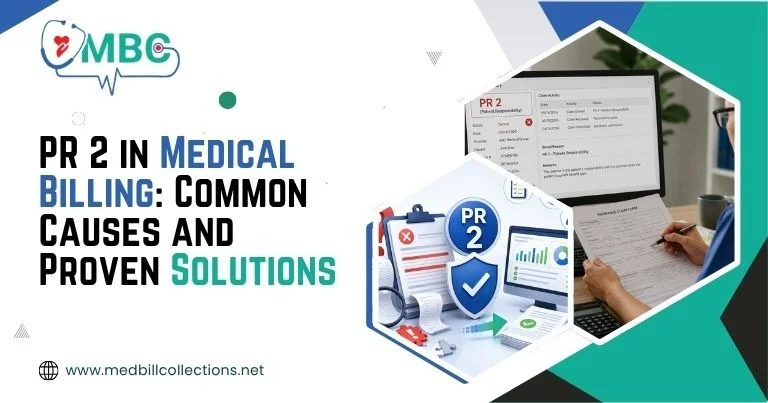
PR 2 is a Claim Adjustment Reason Code (CARC) combination made up of two parts:
PR (Patient Responsibility) — the group code, meaning that the entire balance has been transferred from the plan to the patient because the payer has assumed this responsibility.
2 (Coinsurance Amount) — the reason code, meaning the amount reflects the patient’s coinsurance share under their insurance plan
Together, PR 2 informs the biller that it’s not a denial; it’s the patient’s share of the bill, and it should be sent to the patient directly.
It’s not a problem with the code. The issue is what occurs if practices mishandle it, miscalculating the amount, billing the incorrect party, not following up on patient balances, or otherwise.
Why PR 2 Shows Up So Often on Remittances?
Most commercial and government insurance policies have a common mechanism for cost sharing, known as coinsurance. Many plans have a deductible, and after that, a copay is due, which is often 10% to 30% of the allowed amount, depending on the level of the plan.
Since coinsurance is applied to a significant number of claims, PR 2 is one of the most common adjustment codes that appear on an Explanation of Benefits (EOB) / Electronic Remittance Advice (ERA). This is a common occurrence within a mid-sized practice, with 20% to 40% of claims processed each month containing this code.
Common Causes of PR 2 Errors and Delays
The vast majority of PR 2 problems are not due to the payer. They are a result of issues within its own billing process.
Incorrect Coinsurance Calculation
Sometimes, billing staff use the incorrect percentage, particularly if the patient has multiple plans or a plan change during the year. For high volume, it’s a matter of seconds to a minute, so any miscalculation adds up.
Coordination of Benefits (COB) Errors
If the patient has a secondary insurance plan, the coinsurance amount should be passed to the secondary insurance plan and not the patient. Compliance risk: If it is not done, the patient will be overbilled, and the practice will be at compliance risk.
Outdated Eligibility Verification
If eligibility isn’t checked close to the date of service, practices may apply an old coinsurance rate. Plans will change on an open enrollment basis, and out-of-date data is directly attributed to PR 2 disputes.
Delayed Patient Statements
Some practices delay sending the coinsurance bill to the patient for 30, 60 or even 90 days. The longer the wait, the less likely that it will be collected: the patient simply forgets the context of the visit.
No Clear Patient Communication at Check-In
Patients are much less likely to object to or overlook coinsurance if they are not informed first that coinsurance is applicable.
How Unresolved PR 2 Balances Hurt the Revenue Cycle
PR 2 is not a denial that can be appealed, but is a legitimate amount owed, and it is still a matter that must be managed for it to be realized as revenue. If not corrected, it becomes:
- The aging of A/R that occurs and goes unnoticed at 90-days and 120-days.
- All of the “write-offs” that practices assume are due to the lack of follow-up by staff at the appropriate time.
- Patient dissatisfaction, when bills arrive late or appear inaccurate
- Compliance exposure, if COB rules or plan-specific coinsurance terms weren’t followed correctly
For a practice seeing hundreds of claims a month, even a 10% shortfall in coinsurance collection can translate into a meaningful revenue gap by year-end.
Proven Solutions to Reduce PR 2 Losses
Verify Eligibility and Benefits Before Every Visit
Real-time eligibility checks verify the coinsurance percentage, deductible eligibility, and any secondary coverage, before claims are even submitted.
Automate Coinsurance Calculation
The process of extracting co-insurance percentages from payer contracts in billing software can help minimize manual data entry errors and ensure that the mathematics is uniform for all claims.
Collect Estimated Coinsurance at Check-In
Eligibility information can be provided to front-desk staff that allows them to provide patients with an accurate estimate of their contribution prior to treatment, enhancing transparency and collection rates.
Tighten Coordination of Benefits Workflows
When settling the account with the patient, check the “primary versus secondary payer” status to be sure. This one step is the only step that will avoid most PR 2 disputes related to COB.
Send Patient Statements Within 7–10 Days
Fast, clear statements — ideally with a simple breakdown of what insurance covered versus what’s owed — dramatically improve response and payment rates.
Set Up Structured Follow-Up Cycles
An up-front cadence of 30/60/90-day follow-up avoids putting accounts into “write-off” territory with unpaid coinsurance balances.
Train Staff on Denial Codes vs. Patient Responsibility Codes
Many billing teams consider each adjustment code as if it were a denial. When staff are trained to identify PR codes (patient owes this) from CO codes (contractual write-off), then it helps to avoid wasted appeal efforts and to accelerate the actual collection.
Why More Practices Are Outsourcing This Process
Three areas that are often difficult for in-house teams to manage at scale are consistency of eligibility checks, real-time COB tracking, and disciplined patient follow-up, all of which are necessary to accurately manage PR 2. Eligibility verification, coinsurance, and patient statements are some of the biggest reasons that practices decide on professional medical billing services, as dedicated staff will take these responsibilities as a full-time job instead of a side task.
Outsourced services also offer medical billing collections USA for structured and consistent practices, consistent follow-up cycles, timely delivery of statements, and coordinated follow-up of benefits in accordance with the rules and regulations for compliance.
This can often make up for any lost revenue due to delayed or missed follow-up, which is especially troublesome for practices already feeling the strain on staffing.
Final Thoughts: Turning PR 2 From a Leak into a Predictable Process
PR 2 isn’t a red flag; it’s a routine part of how coinsurance-based insurance plans work. Routine doesn’t have to be automatic. Unresolved PR 2 balances are real revenue that sits on the table waiting to be followed up on, calculated, or sent out a timely statement
The practices that collect this revenue consistently are the ones that treat coinsurance management as a structured process, not an afterthought, verifying eligibility early, communicating costs clearly, and following up before balances age out of reach.
If your team is seeing PR 2 balances pile up faster than they’re being resolved, it may be time to bring in specialists who handle this daily. Reach out to discuss how a dedicated billing partner can tighten your coinsurance workflow and protect the revenue you’ve already earned.