


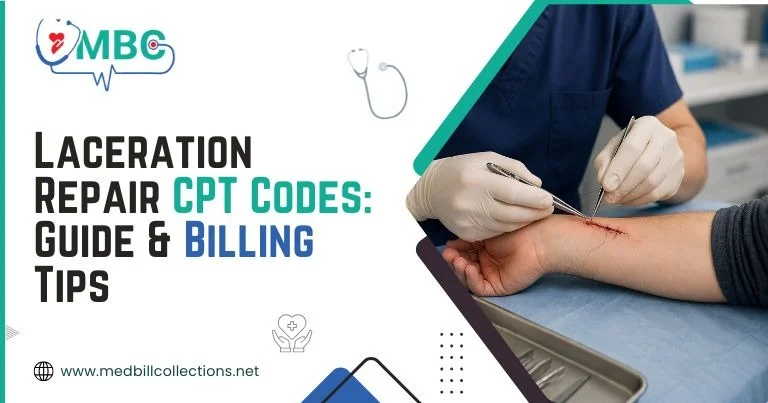
If you’ve ever looked at a chart after a simple cut was stitched up and thought, “Okay… now what do I bill for this?” you’re not alone. Repairing lacerations may be simple in practice, but when it comes to billing, it can be complicated. Sometimes it is the tiniest details that can make or break a claim.
Let’s break this down in a way that actually makes sense.
First Things First: What Counts as a Laceration Repair?
Not all “cuts” are the same.
This is where things get complicated. In CPT, there are three types of laceration repair:
- Simple repair – basic wound closure (think basic suturing)
- Intermediate repair – layered repairs, deeper tissues, etc.
- Complex repair – a more complicated repair, such as scar revision, debridement, or reconstruction
So when people ask what code to bill for sutures, the answer is: it depends on how deep, long, and complex the repair is.
Common CPT Codes You’ll See (And Probably Use Often)
Let’s get into the codes that show up again and again.
- 12011 CPT code – Simple repair of superficial wounds (face, ears, eyelids, nose, lips), up to 2.5 cm
- 12032 CPT code – Intermediate repair of wounds (2.6 cm to 7.5 cm), usually layered
- 12001–12018 range – Simple repair (depends on the location and length of the wound)
- 12031–12057 range – Intermediate repairs
- 13100–13160 range – Complex repairs
If you have something like a finger laceration repair CPT, you’re probably coding a simple repair or intermediate repair unless the finger laceration is through the tendon or nerve.
Here’s where coders go wrong: they select a code based on “what they think it looked like”. But it’s not guessing, it’s recording.
Length Matters More Than You Think
One of the biggest billing mistakes? Failing to consider length.
If a patient has two small wounds on the same limb. If they’re in the same category, you don’t code them separately; you add them together and select the code.
So when you think of the right suture placement CPT code, ask yourself:
1-Do the wounds fall into the same category?
2-Are they the same type of repair?
If yes, combine them.
Documentation: The Make-or-Break Factor
You may have the perfect code, but without proper documentation, it won’t stand.
Here’s what should always be clearly written:
- Specific site of the wound
- Length in centimeters
- Depth of wound (superficial, layered, complex)
- Method of repair (stitches, staples, glue)
- Other procedures (such as cleaning out the wound)
If someone just writes “laceration repaired,” that’s not good enough. And really, that is where a medical billing assistant helps so much; they fill in the blanks to avoid lost revenue.
Don’t Forget About Modifiers
Modifiers can be critical for correct payment.
Some you’ll see often with laceration repairs:
- Modifier 25 – If the provider did a significant, separate E/M service on the same day
- Modifier 59 – Procedures are separate and shouldn’t be bundled
For example, if a patient presents, is evaluated, and has a wound repaired, you may use both codes, but only if you have the documentation to support it.
What About Multiple Repairs?
This is where coding can get tricky.
If there are:
- Different types of repairs (simple + intermediate), you code them separately
- Same type, same location group, you combine lengths
- Different anatomical groups, you may code separately even if the type is the same
So a facial cut and a hand cut? Those are billed differently.
Now Let’s Talk Real-Life Billing Headaches
Let’s talk about something that is not talked about: Denials don’t usually happen because of “spectacular” errors. They happen because of little ones.
- Missing wound length
- Using the wrong classification (simple vs intermediate)
- Not adding lengths together
- Older code ranges
And sometimes, it’s not the CPT side that is the culprit; it is the diagnosis.
That’s where the ICD comes in. So, if the visit is also about chronic issues like medication management icd 10, then this also needs to be coded. Otherwise, the entire visit could be denied as not medically necessary.
A Quick Word on Over-coding (It Happens More Than You Think)
It’s easy to be tempted to use a 12032 CPT code or other higher-paying codes if a repair “looks” complicated. But without note, it’s risky. They don’t audit numbers; they audit notes.
On the other hand, there’s a lot of undercode. People will do a lot of minor repairs for less because they don’t look at the total length and category.
Practical Billing Tips You’ll Actually Use
Instead of giving you textbook advice, here’s what works in real workflows:
- Document wound measurements twice before coding
- Train providers on how to describe depth (this is a big help)
- Use templates, but be smart
- Review problem patterns in denials (you can identify things)
- Be prepared with a “cheat sheet” of common items
And if you’re in a team, hiring someone to do it, like a medical billing and coding assistant, can do wonders for your clean claim rate.
Final Thoughts
Laceration repair coding is not complex because the codes are hard to understand; it’s complex because the devil is in the details.
Even a simple laceration of the finger requires classification, measurement, description, and linking to a diagnosis for payment.
So, whether it be a simple finger laceration repair CPT code or a more complicated code, it’s the same process: slow down, read again, and code what it says, not what you think it should say. And when you do that, you’ll get fewer denials, you’ll get more money, and it will stop being a guessing game.
And that’s exactly the goal!