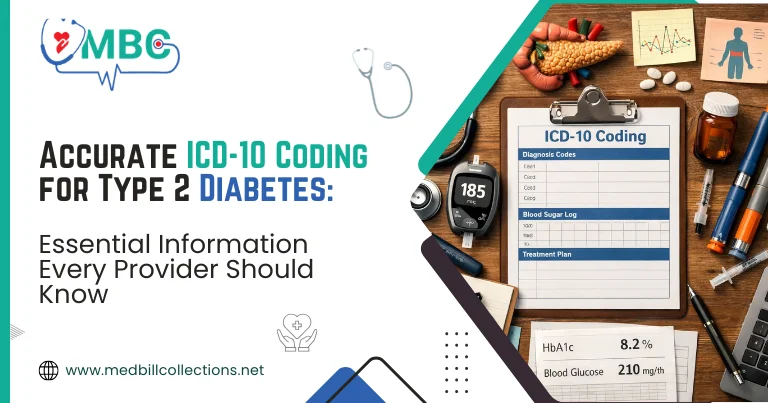
Coding for diabetes is not as simple as it looks. On the surface, it seems that you simply select a code and move forward. However, with type 2 diabetes, the situation soon becomes overlaid. One of the patients has complications, another is taking insulin, and a third one has uncontrolled blood sugar levels. The actual question is then: are you capturing the entire story of your patient in your coding?
That’s exactly what accurate ICD-10 coding is about, telling the complete clinical picture, not just a part of it.
Even minor coding loopholes in 2026 could result in denials or lower reimbursements due to more stringent payer inspection and more intelligent audits. And this is something that, as a provider, biller, or practice manager, you simply cannot afford to ignore.
Why Accuracy in Diabetes Coding Matters More Than Ever
Think about how common diabetes is. A significant proportion of patients worldwide is diagnosed with ICD-10 diabetes type 2, with millions of patients diagnosed each year. Because it’s so common, it’s also one of the most reviewed conditions by insurance companies.
Now imagine this: the patient arrives with uncontrolled diabetes and high glucose levels. You record all this, and all you have coded is a simple diabetes. What happens next? A mismatch is observed by the payer. That might imply underpayment – or even a refusal.
Accurate coding ensures:
- You get paid for the complexity you actually handle
- Your documentation aligns with billing
- You reduce audit risks
It’s not just about compliance. It’s about protecting your revenue.
Understanding the Core ICD-10 Structure for Type 2 Diabetes
ICD-10 does not consider diabetes as one disease. Rather, it divides it into groups according to complications and severity. In the case of type 2 diabetes, the majority of the codes can be classified as E11.
But here’s where it gets interesting: each extension of that code tells a deeper story.
For example, when your patient has high blood sugar levels, you should not stop at a general diabetes code. You ought to use something more precise, such as type 2 diabetes with hyperglycemia, icd 10. Such thoroughness is important as this is active clinical management.
And what about complications? Diabetes rarely comes alone. Neuropathy, nephropathy, and retinopathy are all quite common. And that is where ICD-10 diabetes type 2 with complications comes in. Every complication has its designated extension, and the correct selection of the extension may directly influence reimbursement.
The Role of Documentation: Are You Saying Enough?
Here’s something many providers don’t realize: even perfect coding cannot fix poor documentation.
If your notes don’t clearly state:
- Whether diabetes is controlled or uncontrolled
- Whether complications are present
- Whether the patient is on insulin
…then your coding options become limited.
Let’s take insulin as an example. In case your patient is taking insulin, you must record that using insulin use icd 10. However, unless documented, you cannot code it. And that’s value lost there.
Then the real question is: are your notes that detailed to support the codes you want to use?
Hyperglycemia and Its Impact on Coding
The high glucose levels faced by many patients with type 2 diabetes are a complication that is difficult to handle, but it is usually hidden in the lab report and rarely recorded. Specifically, recording type 2 diabetes mellitus with hyperglycemia icd 10 indicates that the illness is actively influencing the well-being of the patient. Not only does this enhance the accuracy of codes, but it also warrants the medical necessity of treatments and follow-ups.
In simple terms, hyperglycemia is not just a lab value; it’s a coding opportunity.
What’s Changing in 2026? And Why Outsourcing Is Becoming Part of the Conversation
Payers are becoming more data-driven. They are outsourcing to match clinical notes with submitted codes. If something doesn’t align, it gets flagged instantly.
This means:
- Generic coding is more likely to be questioned
- Specificity is no longer optional
- Consistency between notes and claims is critical
Another big shift is the focus on chronic condition management. Diabetes falls right into this category. Outsourcing partners are trained to catch details like ICD-10 diabetes type 2 with complications or properly include insulin use icd 10, just to make sure that nothing important is missed. They also stay updated with payer policy changes, which reduces the chances of denials.
Midway Reality Check: Are You Missing Revenue?
Now, just take a moment and think realistically.
If you are not coding:
- Hyperglycemia when present
- Complications when documented
- Usage of insulin where necessary.
…then you are likely under coding.
And undercoding doesn’t merely entail compliance problems, but it also entails leaving dollars on the table.
Where Support Services Come In
Due to increasingly complex coding requirements, medical billing and credentialing services are becoming the choice of many practices to do the backend work with increased efficiency. The services assist in making sure that all claims capture the extent of care given. They also maintain current payer regulations, making you not always second-guess your coding choices.
Later in the work process, proper monitoring of treatments and prescriptions is frequently linked to medication management icd 10, particularly in chronic illnesses such as diabetes, where continuous treatment is a significant factor.
Common Mistakes You Should Avoid
The most common errors are the use of unspecified codes where there are more detailed options. The other one is the neglect of secondary codes that will give more context, such as the use of insulin. Also, a lot of providers forget to change codes when the condition of the patient changes. Diabetes is not static. A patient who did not experience any complications the previous year might get neuropathy this year. If your coding doesn’t reflect that, it creates a gap.
Making Coding a Habit, not a Hassle
To achieve the highest level of coding accuracy, it is essential that you consider coding as an everyday practice instead of a by-product. Ask the patient at the end of each patient visit:
- Did I capture the type correctly?
- Did I include complications?
- Did I record details of treatment, such as insulin?
These minor checks can pay off in the long run.
Final Thoughts: It’s More Than Just Codes
ICD-10 coding is not all about numbers. It is all about narrating the story of the patient in a manner that is understood and respected by the payers. You are not just billing, you are creating a whole clinical story when you appropriately code ICD-10 diabetes type 2, but you have included such details as type 2 diabetes with hyperglycemia icd 10, and don’t miss elements like insulin use icd 10, you’re doing more than just billing, you’re building a complete clinical narrative.
And in 2026, that narrative is exactly what determines whether your claims get paid smoothly or get stuck in review.
So next time when you code diabetes, make sure you do not hurry. Take a moment. Look deeper. Since the information you record today can directly affect your practice tomorrow.