


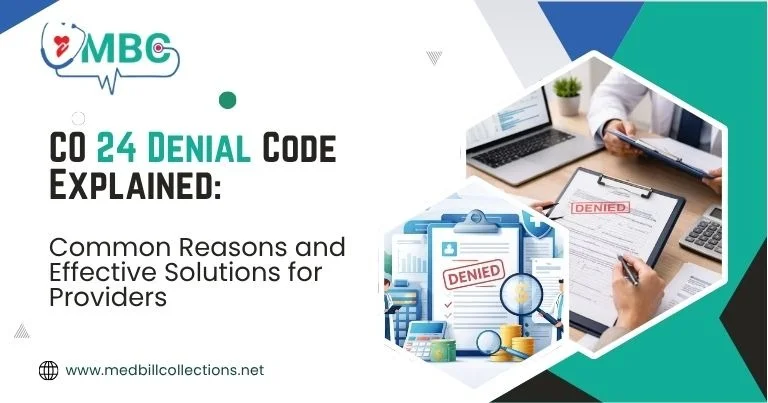
If you’ve been working in medical billing for even a short time, you’ve probably come across the CO 24 denial code. It is one of those annoying rejections that might silently chew on your income unless properly managed. The tricky part? It may seem easy at first glance, but it may be caused by several factors.
Let’s simplify it in the simplest manner so that you can not only get it, but also correct it and avoid it in the future.
What is the CO 24 Denial Code?
CO 24 means:
Charges are covered under a capitation agreement or managed care plan. In simple terms, the insurance payer is saying: We are not claiming this separately because it has already been covered under a pre-arranged payment plan that we already had. This normally occurs where providers are on a capitated contract; they are paid a certain amount per patient rather than per service.
Why Does CO 24 Happen?
This rejection does not necessarily imply that you have done something wrong. At times, it is a matter of a contract.
Here are the most common reasons:
1. Capitation Agreements Not Properly Identified
In case your practice is capitation, and your billing department continues to file fee-for-service claims, you will receive CO 24.
2. Wrong Payer or Plan Selection
This denial can be caused by submitting claims to the incorrect payer, even in the same insurance company.
3. Outdated Patient Insurance Information
By not checking eligibility prior to the visit, you can bill a plan operating under capitation without noticing it.
4. Services Already Included
Certain services are included in the capitation payment, and hence their separate billing results in denial.
5. Lack of Coordination Between Departments
Front desk, clinical, and billing teams tend to operate in isolation. That gap creates errors in understanding coverage.
How CO 24 Impacts Your Revenue
CO 24 rejections can be deadly to your revenue when not managed properly. Such denials are often written off without due consideration, merely because they are presented as a contractual modification.
This makes them easy to overlook, especially in busy billing workflows. The actual problem is that they do not appear as a single occurrence, and they tend to recur in several different claims, forming a pattern that is not immediately detected over a long period.
When this continues unchecked, it leads to consistent revenue leakage, gradually reducing the overall financial performance of your practice.
Step-by-Step: How to Fix CO 24 Denials
Let’s get practical. Here’s what you can do when you see this denial:
Step 1: Verify the Patient’s Plan
Determine whether the patient is covered with a capitated or managed care plan.
- Review payer contracts
- Check with the insurance portal
Step 2: Review Your Contract Terms
Every capitation agreement is different.
Ask:
- Are these services included?
- Should claims even be submitted?
Step 3: Correct the Billing Process
In case the service is part of capitation:
- Do not resubmit the claim
- Modify it to suit contract conditions.
If it’s not included:
- Gather documentation
- Appeal with justification
Step 4: Use Proper Modifiers (If Applicable)
Use appropriate modifiers. In some cases, it can be made clear by adding the modifier right to indicate that a service is independent and chargeable.
Step 5: Train Your Team
Make sure your staff understands:
- Which plans are capitated
- What services are included
- When to bill and when not to
Compliance Matters: HIPAA and Documentation
The process of dealing with denials is not only about payment recovery, but also about being compliant.
You need to follow HIPAA guidelines whenever you access or share patient information, making sure data is handled securely at every step. Meanwhile, you must document every service you bill, and prevent any confusion when it comes to reviews. It is also necessary that any corrections or appeals should be properly audited so that you have a record of what was done and why.
Effective, precise documentation keeps you on track and also secures your practice in the event of an audit, and your appeals will be far more effective.
Coding Accuracy Still Plays a Role
Although CO 24 is contract-related, the mistakes in coding can complicate the situation. For example, when dealing with chronic conditions like diabetes, incorrect coding can confuse the payer about what’s included in care.
You may come across such codes as:
- ICD-10 diabetes type 2 with complications
- Type 2 diabetes with hyperglycemia icd 10
- insulin use icd 10
- ICD-10 diabetes type 2
- Type 2 diabetes mellitus with hyperglycemia icd 10
Unless they are documented and coded appropriately, the payer may assume that the service is in routine management covered by capitation.
Where a Medical Assistant Can Help?
At one stage, it is too much to handle manually, and it is at this point that a medical billing assistant can come in handy. Rather than having to multitask, an experienced assistant is able to monitor denial trends, check patient eligibility prior to submitting claims, and cross-match payer contracts to avoid any unnecessary mistakes.
They are also used to make sure that there is accuracy in coding, and that medication management ICD 10 wherever use is utilized properly, to ensure that claims are clean and compliant at the outset.
On top of that, they handle appeals efficiently, saving your team valuable time. Not only will all this ease the workload, but also enhance reimbursement rates without having to burden your employees.
Final Thoughts
CO 24 denial code might seem like a small issue, but it can quietly impact your revenue if ignored. The key is understanding that it’s not always about errors; it’s often about contracts, communication, and clarity.
When you verify insurance properly, understand your payer agreements, keep your coding accurate, and use the right support systems, you turn what feels like a frustrating denial into a manageable process.
Once your workflow is aligned and your team is on the same page, CO 24 stops being a recurring problem and instead becomes just another controlled and predictable part of your billing system.